Choosing the right builder can make the difference between a smooth renovation and a project filled with delays, unexpected costs and frustration.
Whether you are planning a house extension, full renovation, loft conversion or major refurbishment, the builder you choose will have a direct impact on the quality, budget and overall experience.
A low quote can be tempting, but price alone should never decide who gets the job.
Before signing a contract, every homeowner should take time to check the builder’s experience, reputation, insurance, communication and the detail included in their quote.
Here are the 10 most important things to check.
Choosing the Right Builder Starts With Relevant Experience
The first thing to check is whether the builder has experience with the type of project you are planning.
A contractor who mainly builds new homes may not have the same experience as someone who regularly handles extensions or older property renovations.
Ask whether they have completed projects involving:
- House extensions
- Structural alterations
- Kitchen renovations
- Bathroom renovations
- Loft conversions
- Period properties
- Full refurbishments
Relevant experience matters because different projects come with different challenges.
A builder who has handled similar work is more likely to anticipate problems before they become expensive.
1. Check the Builder’s Previous Work
Ask to see examples of completed projects.
Photos can be useful, but visiting a finished project is even better when possible.
Look at:
- Overall finish
- Joinery
- Flooring
- Tiling
- Brickwork
- Plastering
- Doors and windows
- Attention to detail
Do not only focus on how the project looks in photos.
Ask how long the project took and whether there were any major problems during construction.
Choosing the Right Builder Means Checking References
A professional builder should be willing to provide references from previous customers.
Speak directly to past clients rather than relying only on testimonials shown on a website.
Useful questions include:
- Was the project completed on time?
- Did the final cost stay close to the quote?
- Was communication good?
- Were problems handled professionally?
- Was the site kept reasonably tidy?
- Would you hire the builder again?
One positive reference is useful, but several recent references provide a better picture.
2. Read Reviews Carefully
Online reviews can help you understand how a builder works with customers.
Do not simply look at the overall star rating.
Read both positive and negative reviews.
Look for repeated comments about:
- Communication
- Reliability
- Quality
- Delays
- Hidden costs
- Problem solving
- Cleanliness
- Aftercare
A single bad review may not be a major concern.
However, repeated complaints about the same issue can be a warning sign.
Choosing the Right Builder Requires Proper Insurance
Never assume a builder has the right insurance.
Ask for proof before work begins.
Depending on the project, relevant cover may include public liability insurance and other policies appropriate to the work being carried out.
Insurance can help protect both the homeowner and the contractor if an accident or property damage occurs.
Check that:
- The policy is current
- The business name matches the contractor
- The level of cover is suitable
- Subcontractors are properly covered where required
If a builder avoids discussing insurance, treat that as a warning sign.
3. Ask for a Detailed Written Quote
A verbal price is not enough for a major construction project.
Ask for a detailed written quote that clearly explains what is included.
It should ideally cover:
- Labour
- Materials
- Groundwork
- Structural work
- Waste removal
- Plumbing
- Electrical work
- Plastering
- Decorating
- Windows and doors
- Kitchen or bathroom installation
- VAT or relevant taxes where applicable
The more detailed the quote, the easier it is to compare builders fairly.
A cheaper quote may simply exclude work that another builder has already included.
Choosing the Right Builder Means Understanding What Is Not Included
Exclusions are just as important as inclusions.
Ask the builder to explain clearly what the quote does not cover.
Common exclusions may include:
- Planning fees
- Architect fees
- Structural engineer fees
- Kitchen units
- Appliances
- Flooring
- Light fittings
- Decorating
- Landscaping
Knowing this before work starts reduces the chance of arguments later.
Never assume something is included just because it seems obvious.
4. Compare More Than One Quote
Getting several quotations helps you understand the realistic cost of the work.
You do not need to automatically choose the cheapest or most expensive builder.
Instead, compare:
- Scope of work
- Material quality
- Timeline
- Payment terms
- Experience
- Communication
- Guarantees
If one quote is dramatically cheaper than the others, ask why.
There may be a reasonable explanation, but the quote could also be missing important work.
Choosing the Right Builder Requires Clear Communication
Good communication is essential during a renovation or extension.
Even a highly skilled builder can create frustration if communication is poor.
Before hiring someone, notice how they communicate during the quotation stage.
Do they:
- Reply within a reasonable time?
- Answer questions clearly?
- Explain technical issues properly?
- Turn up when agreed?
- Provide information in writing?
The early stages often give you a good indication of how communication will be handled once the project begins.
5. Ask Who Will Actually Be on Site
The person who provides the quote may not be the person carrying out the work every day.
Ask who will manage the project.
Find out:
- Who will be your main contact
- Who supervises the site
- Which work is subcontracted
- How often the builder will personally attend
- Who handles problems or changes
Knowing who is responsible for what can prevent confusion during construction.
Choosing the Right Builder Means Agreeing on a Realistic Schedule
Ask for an estimated start date and project duration.
Construction timelines can change because of weather, material delays or unexpected structural issues.
However, your builder should still be able to provide a realistic programme.
Discuss:
- Start date
- Expected completion date
- Major stages
- Material lead times
- Planned breaks
- Potential delays
Be cautious if a builder promises an unusually short completion time without explaining how it will be achieved.
6. Check How Many Projects the Builder Is Managing
Some builders take on several jobs at the same time.
That is not necessarily a problem, but you should understand how much attention your project will receive.
Ask:
- How many projects are currently running?
- Will your project have a dedicated team?
- Will workers be on site every day?
- How are delays between projects managed?
A builder who is overcommitted may struggle to maintain progress.
Choosing the Right Builder Includes Reviewing Payment Terms
Never hand over the full project cost before work begins.
A payment schedule should normally be linked to progress or agreed project stages.
For example, payments may be made after:
- Site setup
- Foundations
- Structural work
- Roof completion
- First fix
- Second fix
- Final completion
The exact structure will depend on the project.
Make sure the payment terms are written down before construction starts.
Be cautious about unusually large upfront payment requests.
7. Ask How Changes and Extra Costs Are Handled
Renovation projects sometimes change after work begins.
You may decide to upgrade materials or unexpected problems may require additional work.
Agree in advance how variations will be handled.
A good process should explain:
- What the extra work involves
- Why it is necessary
- How much it will cost
- Whether it affects the timeline
Ideally, additional costs should be approved in writing before the work is carried out.
This helps prevent surprises when the final invoice arrives.
Choosing the Right Builder Means Checking Contracts
A written contract protects both sides.
The contract should clearly explain the responsibilities of the homeowner and the builder.
It may include:
- Scope of work
- Contract price
- Payment schedule
- Start date
- Completion expectations
- Insurance
- Materials
- Variations
- Delays
- Dispute procedures
- Guarantees
Read the contract carefully.
If anything is unclear, ask for clarification before signing.
8. Ask About Guarantees and Aftercare
The relationship with your builder should not necessarily end the day construction finishes.
Ask what happens if a problem appears after completion.
Find out whether the builder provides:
- Workmanship guarantees
- Product warranties
- Defect correction
- Follow-up visits
- Written completion documents
A professional builder should be clear about what aftercare is included.
Choosing the Right Builder Requires Checking Professional Standards
Depending on your location, builders may belong to professional associations or recognised trade organisations.
Membership alone does not guarantee quality, but it can provide an additional layer of confidence.
Check whether memberships are genuine rather than simply trusting logos displayed on a website or vehicle.
You can also ask about relevant qualifications and training.
9. Look at How the Builder Treats the Site
Site management can tell you a lot about a contractor.
If possible, visit one of their current projects with permission.
Look for signs of good organisation such as:
- Safe access
- Materials stored properly
- Waste managed appropriately
- Tools organised
- Protective coverings used
- Reasonably tidy work areas
Construction sites are naturally messy, but they should not feel completely uncontrolled.
Good site management often reflects good overall project management.
Choosing the Right Builder Also Means Trusting Your Judgement
Qualifications, quotes and references matter, but so does your overall impression.
You will probably communicate with your builder regularly for several weeks or months.
Ask yourself:
- Do they listen?
- Are they clear?
- Do they answer difficult questions?
- Do they seem organised?
- Do you feel comfortable discussing money with them?
If something feels unclear during the quotation stage, resolve it before signing anything.
10. Never Choose a Builder Based on Price Alone
The cheapest quote is not always the best value.
A very low price can sometimes mean:
- Missing items
- Lower-quality materials
- Unrealistic labour allowances
- Inexperienced workers
- Extra charges later
- Rushed work
The best value usually comes from a builder who offers a realistic price, clear documentation, good communication and proven experience.
Paying slightly more for reliable workmanship can sometimes save significantly more in repairs and corrections later.
Choosing the Right Builder: Quick Checklist
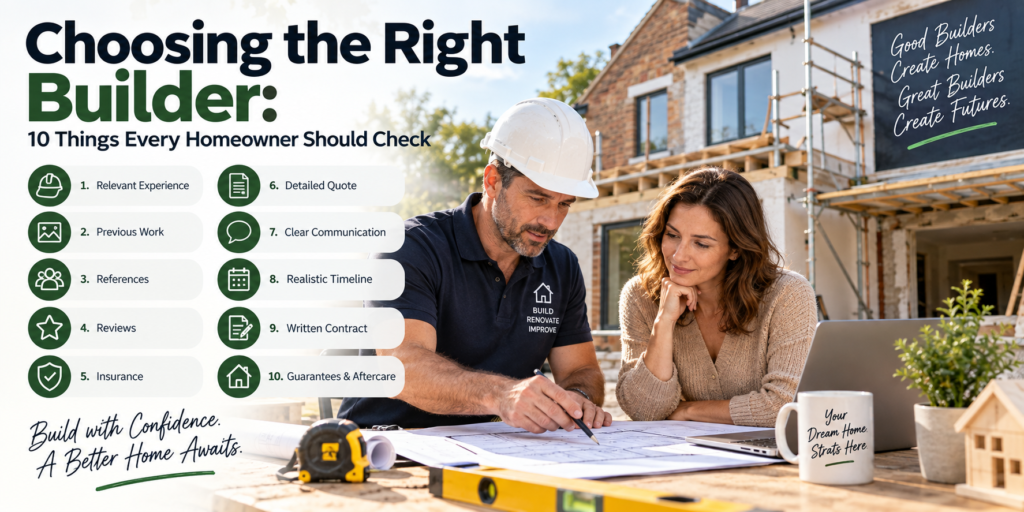
Before hiring a builder, check:
- Relevant experience
- Previous projects
- Recent references
- Online reviews
- Insurance
- Detailed written quote
- Payment schedule
- Project timeline
- Written contract
- Guarantees and aftercare
If you cannot confidently check several of these points, continue researching before committing.
Red Flags to Watch For When Choosing a Builder
Be cautious if a builder:
- Refuses to provide references
- Only gives verbal quotes
- Pushes for immediate decisions
- Requests most of the payment upfront
- Cannot provide proof of insurance
- Gives an unusually cheap quote
- Avoids discussing contracts
- Is difficult to contact before the project even starts
- Cannot explain who will manage the work
One issue does not automatically mean a builder is unsuitable, but several red flags together should make you reconsider.
Final Thoughts on Choosing the Right Builder
Choosing the right builder is one of the most important decisions you will make during a renovation or extension.Take time to compare experience, references, quotations, communication and contracts before signing anything.Do not allow the lowest price to become the only deciding factor.
A reliable builder should be able to explain the work clearly, provide realistic expectations and communicate openly when problems arise.The right contractor will not only build your project.They will help make the entire process more organised, predictable and far less stressful.